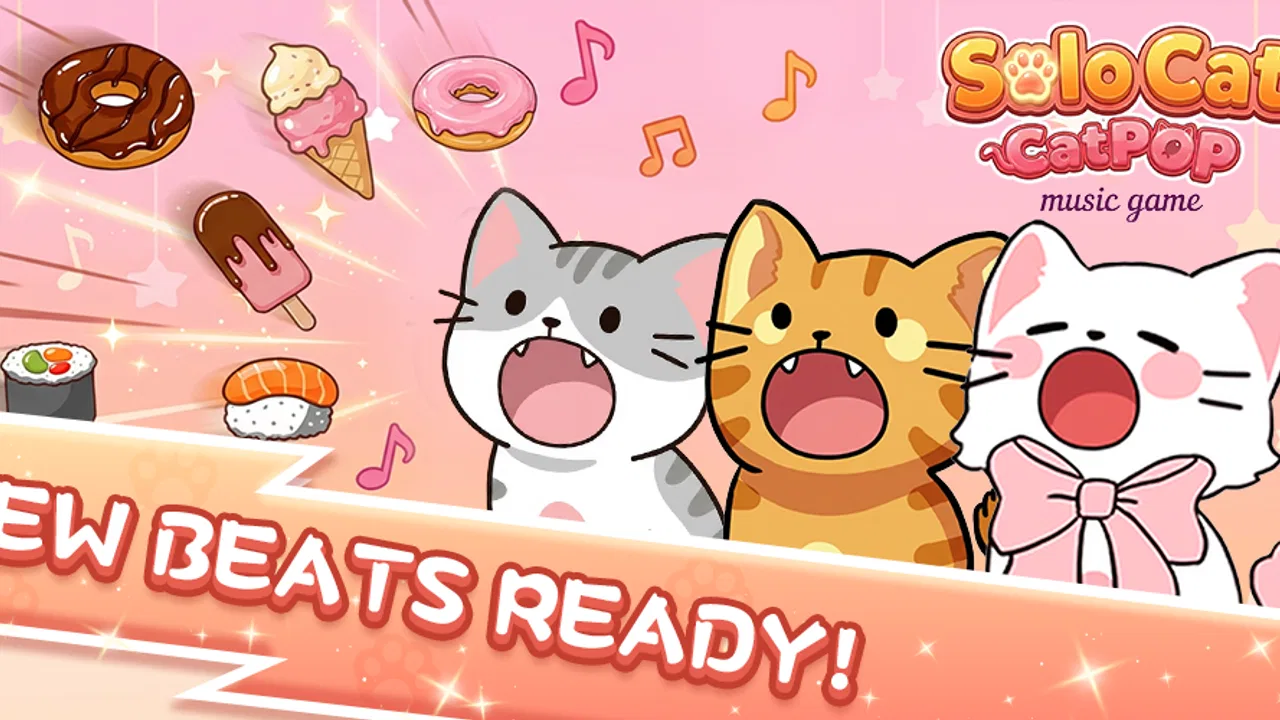
Solo Cat : CatPOP music game
- 4.7
- Rating
- 1.00M
- Installs
- Free
- Price

 Analysis by App-foxy
I approached Solo Cat expecting a small, easygoing music game, and that is exactly where it makes its best impression. Its appeal is immediate: cute cats, pop-focused rhythm play, and controls simple enough to understand without a tutorial-heavy introduction. The game comes from FunGo Studio and is free to start, which makes it easy to try during a short break rather than something I need to plan an evening around.
What interested me most was not whether it could replace a full rhythm game, but whether its short sessions could create a satisfying reason to return. In my experience, Solo Cat works best as a light musical diversion. It is approachable, visually friendly, and suitable for an Everyone audience, while still offering enough timing-based interaction to keep the player involved. It is less convincing for someone looking for deep song charts, serious competition, or a large music library.
How the first sessions establish a reason to play
The early appeal is built around clarity. The cat theme gives the game a recognizable personality, while the pop-music setting keeps the mood upbeat instead of technical or intimidating. I did not feel that I needed previous rhythm-game experience to understand what the game wanted from me. That matters because many music games can overwhelm new players with dense interfaces, complicated note patterns, or several systems introduced at once.
You May Also Like

 Blood Strike: 2.5 Anniversary
Blood Strike’s Loadouts Turn Every Drop Into a Tactical Gamble
A close look at Blood Strike’s custom loadouts: how fast access to signature weapons reshapes its battle royale rhythm, rewards preparation, and narrows the gap between fights.

 Pandora - Music & Podcasts
Pandora’s Music Is Easy to Start, but Harder to Recover
Pandora’s strength is its low-effort path from a seed to a station. Its weak spot is how much confidence it asks you to place in connection, setup, and quiet recovery.

 8 Ball Pool
 Is Built on Rivalries, Rematches, and Routine
A close look at the rivalries, rematches, shared routines, and unanswered safety questions that turn a quick pool match into a persistent mobile community.

 Samsung Music
’s Quiet Strength Is Playing What You Already Own
Its reach comes less from spectacle than from dependable access to a personal library. That simplicity is both the app’s strongest retention engine and its ceiling.

 AccuWeather: Weather Radar
AccuWeather Review: A Quick, Clear Forecast for Everyday Decisions
For everyday plans, the best forecast is the one you can understand quickly. AccuWeather makes rain timing, radar, and local conditions easy to act on, with a few trade-offs.

 Hill Climb Racing
Why Hill Climb Racing Still Turns Crashes Into One More Run
A tiny car, a bumpy hill and one more upgrade: Hill Climb Racing keeps resurfacing because its simple chaos makes every near-miss feel personal.
More From Our News Desk



Solo Cat takes the opposite route. Its first goals feel easy to grasp: follow the rhythm, react at the right moment, and keep improving your performance. Even when a session is brief, the player has a clear task rather than simply tapping through an idle screen. I found that useful when I wanted something interactive but did not have the patience for a long campaign or a complicated setup.
The cat presentation also softens mistakes. Missing a rhythm cue in a serious music game can feel like failure, especially when the song is demanding. Here, the overall tone makes errors easier to accept. I could try again without feeling that the game was judging me, which is an important part of its casual identity. That relaxed approach should appeal to younger players and to adults who enjoy rhythm mechanics without wanting a high-pressure experience.
There is a practical advantage to the simple opening as well. Solo Cat is the sort of game I can imagine using while waiting for an appointment, taking a short break from work, or unwinding before bed. The pop-music format gives those moments a little energy, while the straightforward interaction prevents the game from becoming a project that requires concentration for a long stretch.
Still, players should set their expectations correctly. The early goals are inviting because they are uncomplicated, not because they immediately reveal a complex progression structure. If your favorite part of a rhythm game is studying difficult patterns, optimizing every input, or chasing expert-level scores, the opening may feel too gentle. I would recommend it first to people who value accessibility and atmosphere over technical depth.
Small goals are more important than a large promise
The game’s strongest early loop is the feeling that one more attempt might go better. That is a modest form of motivation, but it suits the design. Instead of relying on a dramatic story or a huge collection of modes, Solo Cat encourages attention through the rhythm itself. I found myself focusing on cleaner timing rather than looking for a complicated objective list.
A useful way to play is to treat each session as a short practice window. Rather than rushing through repeated attempts, I paid attention to the moments where my timing slipped, then tried to stay calmer on the next run. This approach makes the simple controls more meaningful. The game does not need to be mechanically elaborate to reward better concentration.
That said, the early experience may not provide enough variety for every player. Someone who wants a strong narrative hook, extensive customization, or a clearly branching set of goals may find the presentation lightweight. Solo Cat is more successful when judged as a compact rhythm game with a cute identity than when compared with larger music titles built around collecting, competition, or long-term mastery.
Progress signals and the value of another attempt
Progress in a casual rhythm game needs to be visible enough that the player can tell whether practice is helping. Solo Cat communicates improvement primarily through performance: better rhythm, fewer mistakes, and a stronger sense of control. I like this because it keeps the music at the center. The player is not merely waiting for a timer or watching numbers rise without understanding why.
The important distinction is between progress that feels earned and progress that simply unlocks itself. When I replay a section and perform more comfortably, that improvement belongs to me. It comes from listening more carefully and responding with better timing. For a small music game, that is a satisfying kind of progress because it remains connected to the core action.
There is also a useful psychological benefit in the game’s friendly style. A colorful cat theme can make repeated attempts feel less repetitive than a plain interface would. The presentation gives the routine a little warmth, so the player is not only chasing a result but also returning to a pleasant setting. That helps Solo Cat stand out from bare-bones tap games that have similar input but no memorable character.
My main reservation is that performance-based progress can lose its power if the surrounding goals do not continue to develop. A player may enjoy improving at first, then wonder what the next meaningful target is. This is where the game’s casual pacing becomes a trade-off. It is easy to enter and easy to understand, but players who need a strong sense of long-term advancement may eventually want more structure than the basic rhythm loop provides.
How to use the progress loop well
I would not recommend playing every attempt on autopilot. The better approach is to use short, deliberate sessions. Pick a comfortable moment, listen for the musical pattern, and focus on one improvement at a time. If your timing is inconsistent, concentrating on steadiness is more useful than simply tapping faster. If you already understand the rhythm, then trying to maintain accuracy through a full sequence becomes the more interesting challenge.
This also answers a practical question many new players have: is Solo Cat suitable for someone who is not good at rhythm games? Yes, provided that person enjoys gradual improvement and does not expect to master everything immediately. The accessible presentation lowers the barrier to entry, but the player still needs to pay attention. It is not a passive music player; the fun comes from participating.
The game is also a reasonable choice for a shared device used by different age groups. Its Everyone rating and friendly visual direction make it less awkward to hand to a younger family member than a game built around aggressive competition or mature themes. I would still expect each player to enjoy it differently: a child may respond to the cats and music first, while an adult may appreciate the quick, low-commitment sessions.
Difficulty, pacing, and where the challenge becomes less comfortable
The difficulty curve is most effective when it asks for greater attention without turning the game into a test of reflexes alone. Solo Cat’s simple rhythm format gives new players room to settle in. I appreciated that the game feels approachable before it asks me to care about precision. That sequence is important: if the first moments are too demanding, the cute presentation cannot compensate for frustration.
At the same time, a gentle curve has a limit. Players who already spend time with demanding rhythm games may find the challenge too restrained. They may want dense patterns, multiple difficulty tiers, competitive rankings, or a larger range of musical styles. Solo Cat should not be chosen as a technical training tool for advanced rhythm play. Its challenge is better understood as focused casual play, where the goal is to stay engaged rather than prove mastery.
The pacing suits short sessions particularly well. I can play for a few minutes, put the phone down, and return later without feeling that I have abandoned a complicated chain of events. That flexibility is one of the game’s real strengths. It fits into everyday gaps in a way that a story-driven game or a long-form strategy title often cannot.
However, short-session design can also make the experience feel thin if the player wants a substantial evening game. After several attempts, I may want a stronger change of pace, a new type of objective, or a more noticeable escalation. Without that, repetition becomes more apparent. This is not a flaw for every audience, but it is a clear boundary: Solo Cat is built for accessible musical moments, not for replacing a large console-style rhythm experience.
One of the better ways to manage the pacing is to stop before the loop becomes tiring. Because the game is easy to reopen, there is no need to force a long session. I found that leaving after a few focused attempts preserved the pleasant feeling and made returning later more appealing. That is a small but meaningful tip for casual games: the best session length is often shorter than the amount of time the game technically allows.
Who should skip it
I would skip Solo Cat if my priority were a deep catalogue of songs, advanced chart analysis, or a serious competitive ladder. I would also look elsewhere if I wanted a game with a large story, extensive character development, or a complex collection system. The cat theme is charming, but charm alone cannot satisfy someone searching for a feature-heavy music platform.
I would be cautious if I disliked free games that offer in-app purchases. Solo Cat is free to download and play, but optional purchases range from $0.99 to $9.99 per item. That does not automatically make the experience uncomfortable, yet players who prefer a completely purchase-free environment should consider that part of the decision. For me, the important question is whether the basic loop remains enjoyable without treating spending as the main route to satisfaction.
On the other hand, I would recommend trying it to someone who wants a low-pressure rhythm game with a distinct visual personality. It is especially suitable for casual players, families looking for an Everyone-rated option, and people who enjoy music games but do not want to learn a complicated control scheme before having fun.
Retention pressure: what brings me back and what may not
Solo Cat’s retention comes from a combination of quick access, friendly presentation, and the desire to improve timing. Those are honest reasons to return. I do not need to remember a complicated plot, rebuild a large base, or manage a long list of tasks. I can simply open the game, play a rhythm session, and decide whether I want another attempt.
The cat theme helps more than it might seem. A simple mechanic can become forgettable when every screen looks interchangeable. The playful identity gives Solo Cat an emotional hook, even when the underlying action remains familiar. I found that this made the game easier to remember among other casual titles on a phone.
The free entry point also lowers the risk of trying it. With an average rating of 4.7 from around 3.4 thousand ratings, the game has attracted a positive response from its audience, and it has passed the one-million-install mark. Those figures suggest that the approachable formula has found a substantial group of players, but they should not be treated as proof that every rhythm fan will enjoy the same pacing.
The main retention pressure is repetition. If the player does not feel a meaningful difference between a first attempt and a later one, the cute presentation may stop carrying the experience. This is why I think Solo Cat works best when played in bursts and with a personal target, such as improving consistency or completing a session without losing focus. It is less compelling when treated as an endless background activity.
There is also a difference between returning because I want to improve and returning because I feel pushed to keep up. I prefer the first kind of motivation. Solo Cat’s relaxed tone is at its best when it invites another try rather than making the player feel trapped in a long obligation. If optional purchases ever become the main reason to continue, that would weaken the game’s strongest quality: its simplicity.
Compared with a typical music streaming app, Solo Cat offers participation rather than passive listening. Compared with a serious rhythm game, it offers less depth but a softer entry point. Compared with generic tap games, it has a clearer musical identity and a more memorable cat-centered presentation. Those comparisons explain its place well: it is a casual middle ground, not a replacement for either a full rhythm challenge or an ordinary music player.
Practical fit, device expectations, and my progression verdict
Solo Cat is available as a free game in the Music category, with FunGo Studio credited as the developer. It supports Android 7.0 and later, and the current version is 1.7.9. That makes it a practical option for people using older compatible Android devices rather than requiring the newest phone simply to try a lightweight rhythm experience.
The Everyone age rating reinforces the game’s broad accessibility. I can see it fitting into a family tablet, a personal phone used during commutes, or a secondary device where I want something easy to start. The important expectation is that accessibility refers to approachability, not guaranteed mastery. Rhythm still demands attention, and players who want high-level challenge may outgrow the relaxed structure.
My advice for a new player is to begin without worrying about purchases or perfect performance. First decide whether the basic musical interaction feels satisfying. Then play in short sessions and notice whether your timing improves naturally. If the game remains enjoyable when you are focused on the rhythm rather than on collecting every possible reward, it is probably a good match for you.
I also recommend comparing it with your usual alternative before committing time. Choose Solo Cat over a larger rhythm title when you want a cute, low-pressure experience that can be picked up and dropped quickly. Choose a more advanced music game when you want deeper charts, stronger competitive systems, or a longer progression path. Choose a conventional casual game when music is not important to you; Solo Cat’s identity depends on the rhythm interaction being part of the appeal.
After spending time with it, my verdict is positive but specific. Solo Cat is strongest as a short-session rhythm game with a welcoming personality, not as a deep music platform. Its early goals are clear, its progress is easiest to feel through improved timing, and its pacing makes sense for casual play. The trade-off is that repetition and limited depth may reduce its staying power for experienced rhythm players.
For me, the progression works when I create small personal targets and let the game remain light. I would recommend it to a friend who wants pop music, cute cats, and uncomplicated interaction on a free Android game. I would not recommend it to someone seeking a demanding mastery ladder or a huge content library. That honest distinction is what makes the game easier to place: it does not need to be everything to be enjoyable.
In the end, Solo Cat succeeds by keeping its promise small and understandable. It gives the player a pleasant musical activity, a reason to try again, and enough personality to make the experience more memorable than a bare tapping exercise. If that sounds like the kind of break you want from your phone, it is worth trying; if you need a serious rhythm challenge, your time will be better spent elsewhere.
FAQs for Solo Cat : CatPOP music game
01What is Solo Cat: CatPOP music game about?
Solo Cat: CatPOP is a rhythm-based music game where players guide an adorable cat through various levels filled with catchy tunes. The objective is to tap along to the beat, helping the cat navigate obstacles and collect rewards. It's perfect for music and cat lovers looking for a fun and engaging experience.
02Is Solo Cat: CatPOP free to play?
Yes, Solo Cat: CatPOP is free to download and play. However, it offers in-app purchases that can enhance gameplay. These might include additional songs, customization options for your cat, or other features that can improve your experience. Make sure to check the app's store page for detailed pricing information.
03What devices are compatible with Solo Cat: CatPOP?
Solo Cat: CatPOP is available for both Android and iOS devices. It requires a minimum of Android 5.0 or iOS 10.0 to run smoothly. Ensure your device meets these requirements for optimal performance, as older devices may experience lag or other issues while playing.
04Does Solo Cat: CatPOP require an internet connection?
Solo Cat: CatPOP can be played offline, allowing players to enjoy the game without an internet connection. However, certain features like downloading new songs or participating in online leaderboards will require connectivity. It's perfect for playing on the go, but reconnecting occasionally can enhance your experience.
05How can I improve my skills in Solo Cat: CatPOP?
Improving in Solo Cat: CatPOP involves practice and rhythm awareness. Start with easier levels to get accustomed to the gameplay mechanics. Pay attention to the beat and try to memorize patterns. Utilizing headphones can also help you better sync with the music, enhancing your timing and accuracy.
Pros
- Engaging rhythm-based gameplay.
- Colorful and vibrant graphics.
- Wide range of music tracks.
- Intuitive controls for easy play.
- Regular updates with new content.
Cons
- Occasional in-app purchase prompts.
- Ads can interrupt gameplay.
- Limited offline functionality.
- High battery consumption.
- Small learning curve for beginners.

Solo Cat : CatPOP music game
Gallery